






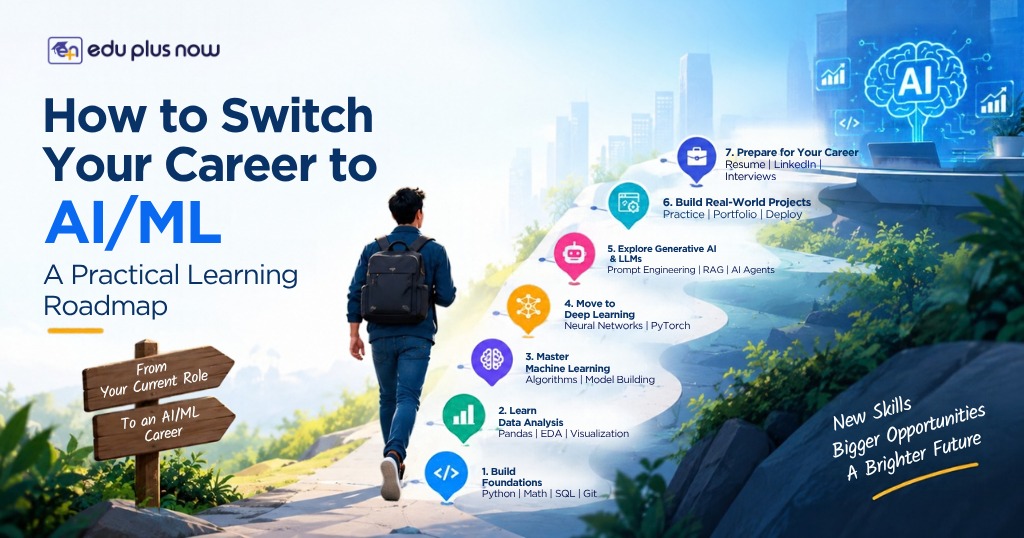
Artificial Intelligence (AI) and Machine Learning (ML) are changing how businesses operate across industries such as finance, healthcare, marketing, manufacturing, retail, logistics, and technology. As organizations adopt AI-driven solutions, professionals with practical AI and ML skills are finding new career opportunities.
If you are considering a career switch to AI/ML, you do not need to learn everything at once. A structured learning roadmap can help you move from the basics to practical skills and eventually become job-ready.
Why Switch Your Career to AI/ML?
AI and Machine Learning are no longer limited to traditional software development roles. Companies are using AI for automation, predictive analytics, customer insights, recommendation systems, fraud detection, natural language processing, and business decision-making.
This creates opportunities for professionals from different educational and professional backgrounds. Whether you are a fresher, software professional, analyst, engineer, marketer, or professional from another domain, learning AI/ML can help you build relevant technical skills.
The key is to choose the right learning path and consistently practice what you learn.
Step 1: Understand the Fundamentals of AI and ML
Before learning advanced tools, start with the fundamentals.
Understand concepts such as:
- Artificial Intelligence and Machine Learning
- Supervised and unsupervised learning
- Regression and classification
- Clustering
- Model training and evaluation
- Feature engineering
- Predictive analytics
- Basic statistics and probability
A strong foundation will make it easier to understand advanced topics later.
Step 2: Learn Python for AI and Machine Learning
Python is one of the most important programming languages for AI/ML. Beginners should become comfortable with Python syntax, functions, data structures, object-oriented concepts, and basic programming logic.
You should also learn commonly used Python libraries such as:
- NumPy
- Pandas
- Matplotlib
- Seaborn
- Scikit-learn
These tools help professionals work with datasets, visualize information, build machine learning models, and evaluate results.
Step 3: Build Your Machine Learning Skills
Once you understand Python and the fundamentals, move into practical Machine Learning.
Learn how algorithms work and when to use them. Important areas include:
- Linear and logistic regression
- Decision trees
- Random forests
- Support Vector Machines
- K-Nearest Neighbours
- Clustering algorithms
- Model evaluation
- Cross-validation
- Hyperparameter tuning
The goal should not be to memorize algorithms. Instead, understand how they solve real-world problems and practice applying them to datasets.
Step 4: Move Into Deep Learning and Advanced AI
After developing a foundation in Machine Learning, you can explore Deep Learning and advanced AI concepts.
Important areas include:
- Neural networks
- Deep learning
- Natural Language Processing (NLP)
- Computer Vision
- Generative AI
- Large Language Models (LLMs)
Frameworks such as TensorFlow, PyTorch, and Keras can help you develop and experiment with AI models.
Learning these technologies can also prepare you for modern AI applications involving text, images, automation, and intelligent systems.
Step 5: Choose Practical AI/ML Training
Self-learning is useful, but structured training can provide a clear curriculum, expert guidance, and practical project experience.
When searching for ai ml courses in pune, compare the curriculum, trainers, practical learning, projects, certification, learning format, and career support rather than choosing a course based only on advertisements.
Similarly, professionals looking for machine learning classes in pune should check whether the program provides opportunities to work with real datasets and industry-oriented case studies.
A good program should help you move from theoretical concepts to practical implementation.
Step 6: Build Real-World AI/ML Projects
Projects are an important part of a career transition because they demonstrate your ability to apply technical knowledge.
Beginner-friendly project ideas include:
- Customer churn prediction
- Sentiment analysis
- Employee attrition prediction
- Sales forecasting
- Recommendation systems
- Stock price analysis
- Customer complaint classification
- AI-powered content generation
edu plus now’s AI/ML program includes hands-on projects and industry-oriented case studies, including sentiment analysis, employee turnover prediction, complaint analysis, and AI-based content generation.
Step 7: Create an AI/ML Portfolio
Once you have completed a few projects, create a portfolio to showcase your skills.
Your portfolio can include:
- GitHub projects
- Project explanations
- Technologies used
- Dataset information
- Model-building process
- Results and insights
- LinkedIn posts or articles
A strong portfolio can help recruiters understand what you can actually build rather than only seeing a list of courses on your resume.
Step 8: Choose the Right AI Course for Your Career Goal
Not every AI course is suitable for every learner. Beginners should look for programs that start with fundamentals and gradually introduce advanced concepts.
When comparing the best AI courses for beginners, consider:
- Beginner-friendly curriculum
- Python and ML fundamentals
- Practical projects
- Deep Learning and NLP
- Generative AI and LLMs
- Expert-led training
- Certification
- Career guidance and placement assistance
edu plus now offers an Advanced PG Program in Data Science with AI & ML with online and offline learning options. The program covers Machine Learning, Deep Learning, NLP, Generative AI, LLMs, SQL, Spark, AWS, Computer Vision, and Power BI, along with hands-on projects and career support.
Career Opportunities After Learning AI/ML
After developing the right skills and practical experience, you can explore roles such as:
- Machine Learning Engineer
- AI Engineer
- Data Scientist
- AI/ML Developer
- NLP Engineer
- Computer Vision Engineer
- Generative AI Developer
- Business or Data Analyst
Your previous professional experience can also become an advantage. For example, someone from finance can explore AI applications in financial services, while a marketing professional can work with customer analytics, recommendation systems, and Generative AI.