






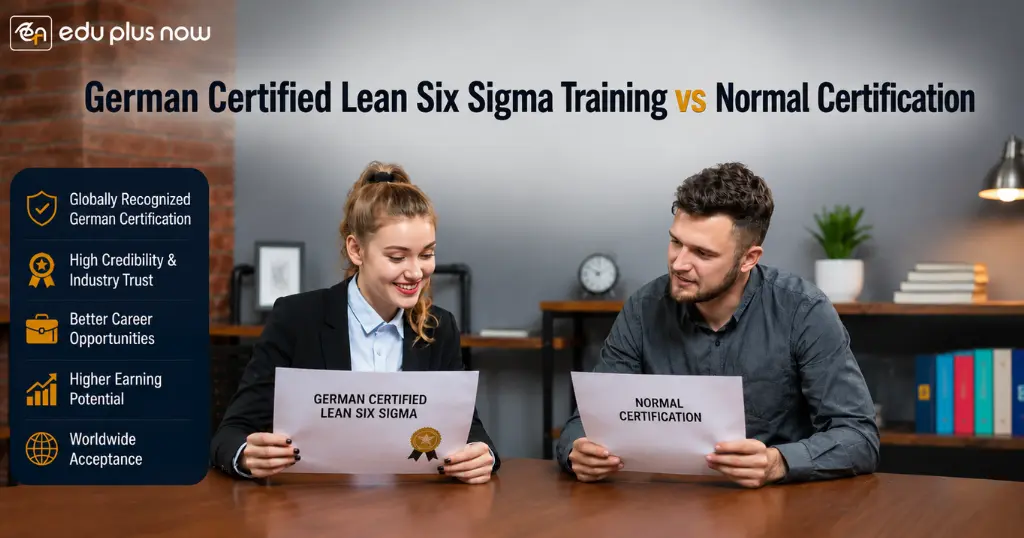
In today’s competitive business environment, organizations are constantly looking for professionals who can improve quality, reduce operational inefficiencies, and drive continuous improvement. This growing demand has made Six Sigma one of the most sought-after professional certifications across industries. However, many learners face an important question before enrolling: Should you choose German Certified Lean Six Sigma Training or a normal Six Sigma certification?
While both certifications introduce the fundamentals of process improvement, there are significant differences in terms of credibility, industry recognition, training standards, and career impact. Understanding these differences can help professionals make a smarter investment in their future.
Understanding Six Sigma Certification
Six Sigma is a globally recognized methodology focused on improving business processes by reducing defects, minimizing variations, and enhancing overall quality. It uses structured frameworks such as DMAIC (Define, Measure, Analyze, Improve, Control) to identify problems and implement sustainable solutions.
Today, Six Sigma principles are widely used in manufacturing, healthcare, logistics, operations, quality management, supply chain management, and service industries. As organizations continue to focus on operational excellence, professionals with Six Sigma expertise are becoming increasingly valuable.
What Is German Certified Lean Six Sigma Training?
German Certification follows internationally recognized standards established by leading certification bodies such as TÜV SÜD. These certifications are known for their strict quality benchmarks, comprehensive curriculum, and practical approach to process improvement.
A German-certified program focuses not only on theoretical concepts but also on real-world implementation. Professionals are trained to solve actual business challenges, conduct root cause analysis, perform process mapping, and drive measurable improvements within organizations.
At edu plus now, our Six Sigma training is aligned with globally recognized standards, helping learners gain industry-relevant knowledge and internationally respected certification credentials.
German Certified Lean Six Sigma Training vs Normal Certification
One of the biggest differences lies in global recognition. While a normal certification may be accepted locally, TUV certification and TUV German certifications are respected by organizations worldwide. Employers often associate German certifications with quality, consistency, and professional excellence.
Another major distinction is the training methodology. Standard certifications frequently focus on completing course modules and passing assessments. German-certified programs emphasize practical applications, case studies, project-based learning, and process improvement strategies that can be implemented immediately in the workplace.